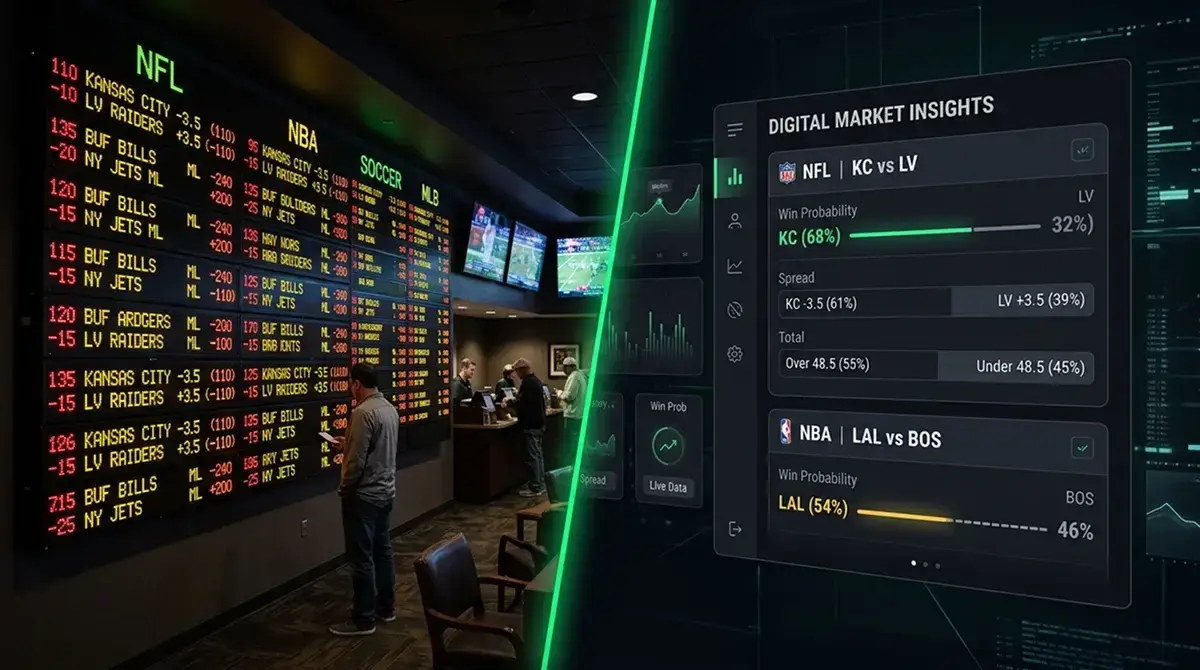
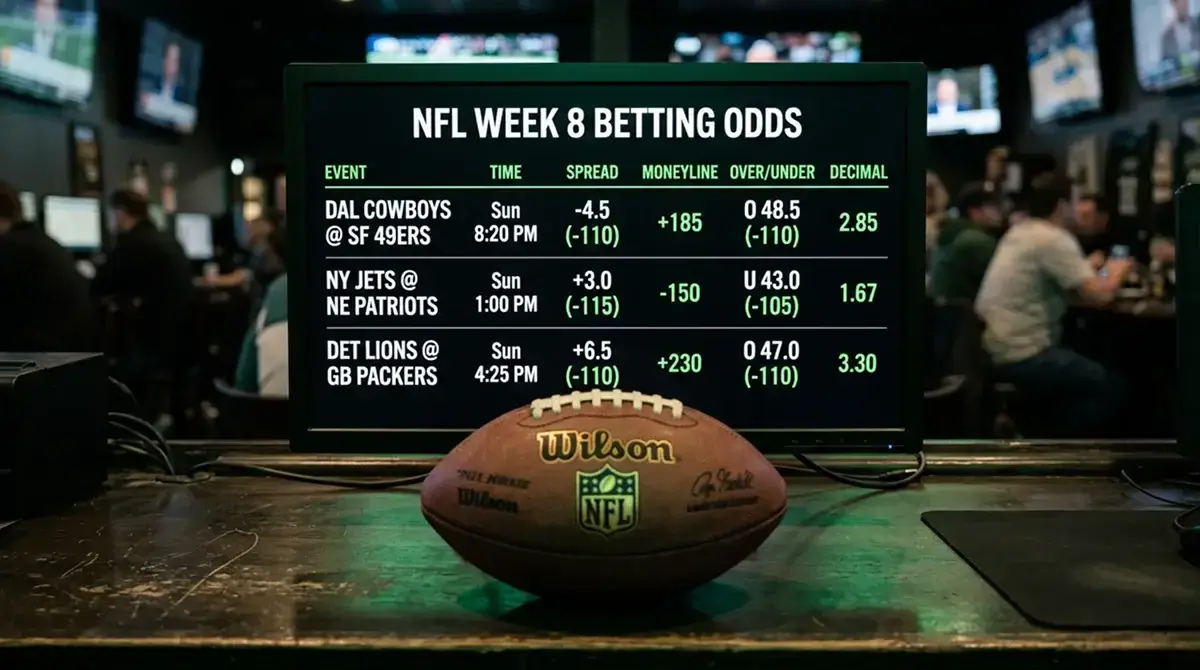
Americans wagered approximately £24 billion on the NFL during the 2025 season through legal sportsbooks alone, according to the American Gaming Association, an 8.5% jump from the previous year. That volume produces some of the sharpest, most efficient betting lines in all of sport. When UK bettors step onto crypto sportsbooks to access those same NFL markets, they encounter a different odds ecosystem: American-format lines by default, margins that vary wildly between platforms, and line movement patterns shaped by a smaller, more volatile liquidity pool.
If you have been betting on Premier League or Champions League football with UK bookmakers and are now looking at NFL odds on a crypto platform, the experience feels disorienting. The numbers look different, the format is unfamiliar, and you cannot tell at a glance whether -110 is a good price or a bad one. That disorientation costs money because it leads to uninformed bet placement by accepting whatever odds are on the screen without understanding the margin baked into them.
I have spent the better part of a decade reading NFL lines across both regulated UK bookmakers and offshore crypto platforms. The gaps in how odds are displayed, priced and moved create both confusion and opportunity. This guide bridges the gap: starting with the formats themselves, working through the maths of implied probability and margin, and ending with practical methods for finding value that most crypto bettors overlook.
Understanding these numbers is crucial before you dive into specific NFL moneyline and point spread bets.
American, Decimal and Fractional Crypto Odds Comparison
The first time I opened a crypto sportsbook’s NFL page, every line was displayed in American format. As someone who grew up with fractional odds on UK high streets and had migrated to decimals for online betting, the minus and plus signs felt like a foreign language. They are not difficult once you understand the logic, but the initial disorientation is real, and it costs money if you place a bet without fully understanding what the odds mean.
American odds revolve around the number 100. A negative number tells you how much you need to stake to win 100 units. A positive number tells you how much you win from a 100-unit stake. So -150 means you stake 150 to win 100 (plus your stake back). +130 means you stake 100 to win 130. The favourite always carries the minus sign; the underdog gets the plus. If you are used to thinking in terms of “how much do I get back for every pound I put in,” American odds require a mental conversion that feels unnatural at first.
Decimal odds, standard across most European betting platforms and increasingly common on UK-facing sites, express the total return per unit staked. Odds of 1.67 mean a 1 GBP bet returns 1.67 GBP (0.67 profit plus your 1 GBP stake). Odds of 2.30 return 2.30 GBP from a 1 GBP bet. The maths is simple multiplication: stake times odds equals total return. This is the format I recommend UK bettors use whenever the sportsbook offers a display toggle (and most crypto platforms do), buried somewhere in the settings menu.
Fractional odds (4/6, 13/10, 5/1) are the traditional UK format and still appear on high-street bookmaker boards. The first number is the potential profit; the second is the stake required. So 4/6 means you stake 6 to win 4. Fractional odds are intuitive for simple cases but become awkward for precise pricing. What is the fractional equivalent of -108? It is 25/27, which nobody uses in practice. This is one reason crypto sportsbooks default to American or decimal, as both handle fine-grained pricing more cleanly.
Converting between formats is mechanical. To go from American to decimal: for negative odds, divide 100 by the absolute value of the American odds and add 1. So -150 becomes (100/150) + 1 = 1.667. For positive odds, divide the odds by 100 and add 1. So +130 becomes (130/100) + 1 = 2.30. To go from decimal to fractional, subtract 1 and express the result as a fraction (2.30 becomes 13/10). These conversions matter because comparing odds across platforms requires a common format. I keep everything in decimals for consistency, making margin calculations and cross-platform comparisons faster.
Why do crypto sportsbooks default to American format? Because their odds feeds overwhelmingly originate from US-facing markets. NFL is an American sport, priced primarily by American oddsmakers, and the data flows outward from that centre. Crypto platforms, many of which operate globally without a single home market, adopt American format because it matches their source data. For UK bettors, the practical lesson is simple: switch your display to decimal in the sportsbook’s settings, and you will never need to do mental arithmetic on a -115 line again.
Calculating Implied Probability from NFL Odds
Odds are not just prices. They are probability statements. Every set of odds implies a likelihood of an outcome occurring, and understanding that implied probability is the foundation of every profitable betting decision I have ever made.
The formula for decimal odds is straightforward: implied probability equals 1 divided by the decimal odds, expressed as a percentage. Odds of 1.91 imply a probability of 1/1.91 = 52.36%. Odds of 2.10 imply 1/2.10 = 47.62%. For American odds, the calculation differs depending on whether the number is positive or negative. For negative odds: implied probability = absolute value of the odds divided by (absolute value + 100). So -150 gives 150/(150+100) = 60%. For positive odds: implied probability = 100 divided by (odds + 100). So +130 gives 100/(130+100) = 43.48%.
Here is where it gets interesting. On a two-way market (say, Chiefs moneyline versus Bengals moneyline) the implied probabilities of both sides should add up to 100% if the odds were perfectly fair. They never do. The sportsbook inflates both sides so the combined implied probability exceeds 100%. That excess is the overround, also called the vig or juice. If one side is priced at 1.91 (52.36%) and the other at 1.91 (52.36%), the combined implied probability is 104.72%. The overround is 4.72%, and that is the sportsbook’s theoretical margin on the market.
This overround is not uniform across all markets on the same sportsbook. Main markets (moneylines and point spreads for high-profile NFL games) tend to carry the tightest margins because they attract the most volume and scrutiny. Player props, alternative spreads, and team totals typically carry wider margins, sometimes 8% or more, because fewer bettors check the maths on those markets. I make it a habit to calculate the overround on every market I consider betting, not just the headline markets. The difference in margin between a standard spread and an alternative spread on the same game can be 3 to 4 percentage points, enough to turn a marginally profitable bet into a losing one.
To find the “true” implied probability stripped of the overround, divide each side’s implied probability by the total. In the example above: 52.36% / 104.72% = 50.0% for each side, a coin flip, which is exactly what you would expect when both sides are priced identically. When the odds differ (say, 1.50 and 2.70) the same method reveals the sportsbook’s genuine probability estimate, which you can then compare against your own assessment. If you believe a team has a 60% chance of winning but the sportsbook’s de-vigged probability puts them at 65%, the market considers them a stronger favourite than you do, and the bet has negative expected value by your model. If you see 55%, you have found potential value.
Odds Margins: Crypto Sportsbooks vs UK Bookmakers
Not all margins are created equal, and the differences between crypto sportsbooks and traditional UK bookmakers on NFL markets are larger than most bettors realise. I tracked margins across eight platforms during the 2025 NFL season (four crypto, four UK-licensed) and the spread was striking.
Traditional UK bookmakers ran NFL point spread margins between 4.5% and 6.0% on regular-season games, tightening slightly to 4.0% to 5.0% during the playoffs when public attention (and volume) increased. This is consistent with their approach to football (soccer), where Premier League match odds typically sit in the 3% to 5% range. NFL gets slightly wider margins because UK bookmakers view it as a secondary sport with less liquidity and less sophisticated bettor demand.
Crypto sportsbooks showed far more variance. The tightest crypto platform I tracked averaged 3.2% on NFL spreads, genuinely cheaper than any UK-licensed alternative. The widest averaged 7.8%, which is highway robbery on a market as liquid as the NFL. The difference between 3.2% and 7.8% compounds brutally over a season. On 500 bets at 100 GBP each, a 3.2% margin costs you roughly 1,600 GBP in theoretical edge lost to the house. A 7.8% margin costs you 3,900 GBP. That gap of 2,300 GBP is real money lost purely to choosing the wrong platform.
DraftKings’ Q4 2025 earnings provide useful context. The company handled £13.3 billion in NFL volume and generated £1 billion in sports betting revenue, a 63% year-on-year surge. CEO Jason Robins described the quarter as closing 2025 on a high note, with record revenue and adjusted EBITDA. That revenue-to-handle ratio implies a blended margin across all sports, but it anchors what a large, well-capitalised operator retains. Crypto sportsbooks with margins significantly above that benchmark are either pricing inefficiently or deliberately targeting less price-sensitive bettors.
The FanDuel-DraftKings duopoly controls roughly 75% of the regulated US market, per CompaniesHistory data. Their pricing sets the benchmark that sharp bettors and oddsmakers use globally. Crypto sportsbooks that source odds from the same data feeds but add wider margins are effectively charging you a premium for the privilege of paying in Bitcoin. Know what you are paying. If the margin exceeds 5% on NFL point spreads, the platform is not offering you competitive value, regardless of how fast its withdrawals are.
Line Movement and Steam Moves on Crypto Platforms
Lines move. That is not a bug – it is the entire mechanism by which sportsbooks manage risk and reflect new information. But on crypto platforms, line movement has a different character than on established regulated sportsbooks, and understanding that difference is worth real money.
NFL lines open early in the week, typically Sunday evening or Monday for the following week’s games. Sharp bettors – professionals and syndicates – hit the opening lines hard, forcing adjustments. By Tuesday or Wednesday, the “look-ahead” lines have stabilised into something close to the consensus. On major regulated sportsbooks, this process is orderly, driven by enormous liquidity and sophisticated risk management. Lines move in small increments: a half-point here, a ten-cent shift there.
On crypto sportsbooks, the same process plays out with less liquidity and less sophisticated risk management. The result is sharper, more volatile line movement. A single large bet – possible because crypto platforms often have higher anonymous betting limits – can push a spread by a full point on a smaller platform, whereas the same bet would barely register on a major US sportsbook. These sharp moves are called “steam moves,” and they create both risk and opportunity.
Tracking line movement across platforms is essential. I maintain a simple spreadsheet where I log the opening line, the line at the time I bet, and the closing line for every NFL wager I place. Over a season, this data reveals patterns: which crypto sportsbooks react fastest to sharp action, which ones lag behind the consensus, and which ones move erratically based on their own liability rather than market-wide sentiment. That information shapes my platform selection week by week.
The risk is that you place a bet at a price that is already stale. If a crypto sportsbook’s line has not yet adjusted to reflect sharp action that has already moved lines on regulated platforms, you might think you are getting value when you are actually betting into an outdated number. The opportunity is the reverse: if a crypto platform moves its line faster than the consensus – reacting to a single sharp bet rather than waiting for confirmation across the broader market – you can find value on the other side of the move before regulated sportsbooks catch up.
Live betting amplifies these dynamics. In-play markets account for over 62% of online sports betting revenue globally, per Precedence Research data, and they grow at 13.62% annually. On crypto platforms, live NFL odds can swing dramatically between plays because the odds engine is working with less data and less liquidity than a regulated counterpart. I have seen live spreads shift by three points on a single drive change during a close game – movement that would take a major sportsbook an entire quarter to replicate. If you understand the game well enough to anticipate these overreactions, live betting on crypto platforms offers edges that simply do not exist on more efficient markets.
Finding Value in NFL Odds on Blockchain Sportsbooks
Finding value is not about picking winners. I need to say that clearly because it is the single most misunderstood concept in sports betting. Value exists when the odds offered imply a probability that is lower than the true probability of the outcome. You can find value on a team you expect to lose – if the odds against them are too generous relative to their actual chances.
On crypto sportsbooks, value emerges from three sources. The first is margin disparity. As I detailed above, some crypto platforms run significantly wider margins than others. If two sportsbooks both agree that a team has a 55% chance of winning but one prices the market at 1.80 and the other at 1.85, the second offers better value – you are paying less for the same probability. Line shopping across multiple crypto platforms is the simplest and most reliable source of value. It requires no analytical skill, just the discipline to check two or three sportsbooks before placing every bet.
The second source is closing line value, or CLV. NFL lines sharpen as kickoff approaches because more information flows into the market – injury reports, weather updates, sharp bettor action. If you consistently beat the closing line – meaning the odds you bet at are better than the odds available at kickoff – you are extracting value from the market over time. On crypto sportsbooks, where early-week lines tend to be softer than on regulated platforms, the window for CLV is often wider. Betting on Tuesday or Wednesday, before the sharpest money has moved the lines, gives you a better chance of beating the close.
The third source is cross-market arbitrage. Because crypto sportsbooks operate independently from regulated UK bookmakers and major US platforms, their lines can diverge meaningfully – especially on lower-profile markets like team totals, alternate spreads, and player props. NFL is by far the most heavily bet sport in the United States, with a single Sunday game slot generating more volume than entire weeks of other major leagues. But not all of that volume reaches crypto platforms equally. Props and alternative lines are often the last markets to adjust on crypto sportsbooks, making them fertile ground for bettors who compare prices across the ecosystem.
Value betting is a volume game. No single bet is guaranteed to win, and even bets with genuine value lose regularly. The edge compounds over dozens and hundreds of wagers, not over a single Sunday. If you are betting on the NFL with crypto, commit to tracking every bet – the odds you took, the closing odds, the result – and review your CLV at the end of each month. That data will tell you more about your betting skill than your win-loss record ever could.
Maximizing your returns requires discipline and choosing the most reliable crypto platform for NFL wagering.