
Search for “best crypto NFL betting sites” and nine out of ten results are affiliate-driven listicles. Each one ranks five to eight sportsbooks, slaps a “recommended” badge on whichever pays the highest referral commission, and buries a tiny disclaimer at the bottom. I have spent nine years in this space, and I can tell you that those lists are not evaluations. They are advertisements wearing a review’s clothing.
This article takes a different approach. The crypto gambling market hit £64 billion in revenue in 2025 – a fivefold surge from £13 billion in 2022, per BitcoinEthereumNews and MEXC News data – and a growing slice of that volume flows through NFL markets. With that kind of money in motion, UK bettors need a genuine framework for assessing platforms, not a ranking that changes every time a sportsbook renegotiates its affiliate deal.
I am not going to tell you which sportsbook to use. I am going to give you the tools to decide for yourself, so you can evaluate any platform that crosses your path, today, next season, or five years from now. The framework covers six dimensions: licensing, NFL market depth, crypto payment options, odds quality, payout reliability and user experience. By the end, you will know exactly how to separate the legitimate operators from the ones that will lose your deposit and sleep soundly.
Licensing and Jurisdictions: Essential UK Bettor Compliance
Last year I watched a well-known crypto sportsbook lose its Curaçao licence overnight. Players had 72 hours to withdraw funds. Some made it. Many did not. That episode confirmed what I tell every UK bettor who asks me for advice: the licence a platform holds is not a bureaucratic detail. It is the single most important factor in whether your money is safe.
No UKGC-licensed operator accepts cryptocurrency deposits in 2026. That means every crypto sportsbook available to UK players operates under a foreign jurisdiction. The most common are Curaçao, Malta (MGA), Gibraltar and the Isle of Man, and they are not interchangeable. A Curaçao eGaming licence is the easiest to obtain and the weakest in enforcement. The regulator issues master licences to sub-licensees, audit requirements are minimal, and dispute resolution for players is practically non-existent. If a Curaçao-licensed sportsbook refuses to pay you, your realistic options are limited to leaving a bad review.
Malta’s Gaming Authority operates at a different level entirely. MGA licensees face regular compliance audits, mandatory player fund segregation, and a functioning dispute mechanism. An MGA licence is harder and more expensive to acquire, which is precisely why it matters. A sportsbook that invests in MGA compliance is signalling that it plans to operate long term. Gibraltar and Isle of Man licences fall in a similar tier, with strong regulatory frameworks and a genuine track record of enforcement.
The UKGC itself has been aggressive against unlicensed operators targeting British consumers. In 2025, the Commission issued 480 cease-and-desist notices and flagged 188,297 URLs to search engines, resulting in over 104,000 removals and 504 sites blocked or geo-restricted in the UK. Andrew Rhodes has stated publicly that the Commission considers it wrong for companies sponsoring British football clubs to operate without a UK licence. That enforcement pressure means a crypto sportsbook without any licence is not just risky. It is actively in the crosshairs of a regulator with increasing reach.
My threshold: I will not deposit on any platform that does not hold at least a Curaçao licence, and I strongly prefer MGA, Gibraltar or Isle of Man. If a sportsbook cannot even clear the lowest regulatory bar, there is no reason to trust it with your Bitcoin.
NFL Market Depth: What to Expect from Crypto Sportsbooks
A crypto sportsbook might tick every licensing and payment box, but if its NFL coverage is shallow, it is useless for serious NFL betting. And shallow coverage is more common than you would expect. Some platforms treat American football as a secondary sport, offering moneyline bets on primetime games and nothing else. That is not enough.
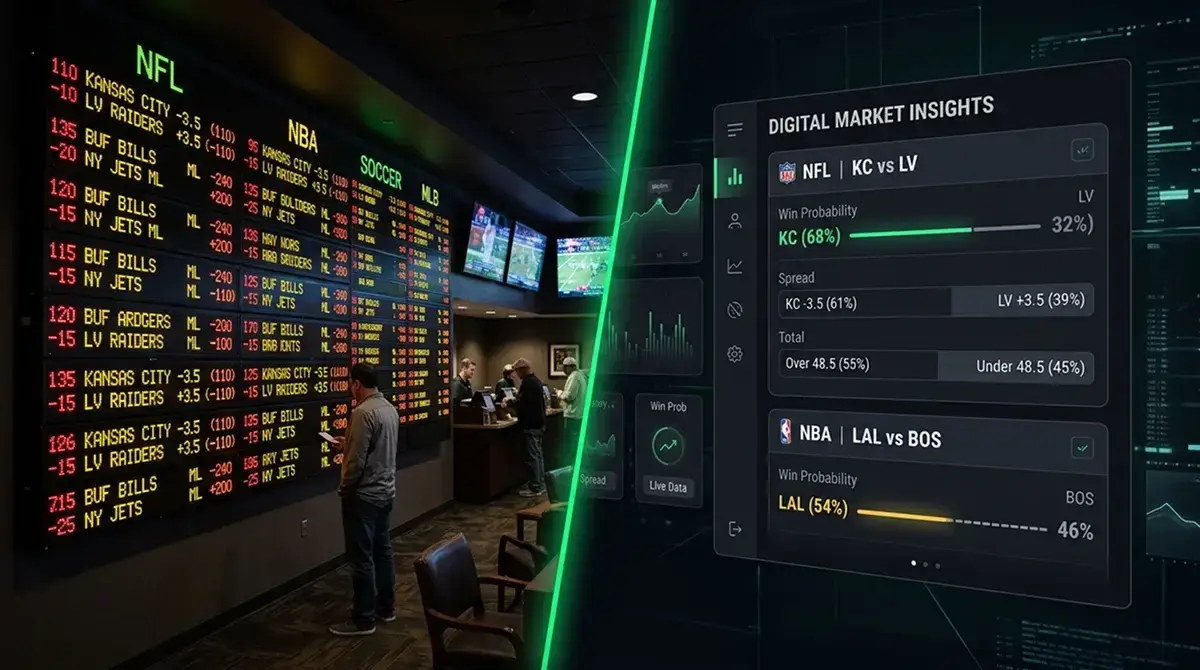
NFL dominates the US sports betting landscape. A single Sunday game slot regularly generates more wagering volume than entire weeks of MLB or NBA action, according to RG.org data. That dominance creates deep, liquid markets on established sportsbooks: dozens of prop bets per game, player performance lines, team totals, quarter-by-quarter spreads, and alternative lines at every half-point increment. UK bettors accustomed to the depth of Premier League markets on domestic bookmakers should expect comparable depth from any crypto sportsbook worth using for NFL.
When I evaluate a platform’s NFL offering, I check four things. First, does it cover every regular-season game, not just Sunday Night Football and Monday Night Football? If Thursday afternoon games or early-window fixtures are missing, the platform’s data feed is incomplete. Second, does it offer point spreads and totals alongside the moneyline? These are the bread-and-butter markets for NFL bettors, and their absence suggests a platform that is not set up for American football. Third, player props – passing yards, rushing attempts, receiving touchdowns, anytime touchdown scorer. These markets are where much of the betting action concentrates, and they are also where crypto sportsbooks most often fall short compared to traditional UK bookmakers. Fourth, futures markets. Super Bowl winner, conference winners, MVP, division champions, and season win totals should all be available from the summer through to the playoffs.
Depth also means having markets open at reasonable times. Traditional UK bookmakers often post NFL lines by Tuesday of game week. If a crypto sportsbook is not posting until Friday, you are losing three days of line shopping and early-week value. I have tracked this across several platforms, and the gap is significant – early-week lines on crypto sportsbooks tend to be softer (less sharp) because the platforms receive less action from professional bettors in those first 48 hours. That softness is an edge, but only if the lines are actually available.
Also pay attention to how the sportsbook handles London games. With the NFL expanding its International Series – seven games in 2025, three of them at Wembley and Tottenham Hotspur Stadium – UK bettors have a natural interest in these fixtures. A crypto sportsbook that treats London games the same as any other regular-season fixture, with full prop and spread coverage, demonstrates that it takes its UK user base seriously. One that barely posts markets for a game happening on British soil does not.
Supported Cryptocurrencies and Payment Speed
Which cryptocurrencies a sportsbook accepts tells you something about how seriously it treats the crypto betting experience. A platform that only takes Bitcoin is functional but limited. One that supports BTC, Ethereum, Litecoin, and stablecoins like USDT and USDC offers genuine flexibility – and stablecoins in particular are the fastest-growing payment method in the space.
Bitcoin still dominates at roughly 66% of all crypto gambling volume, per Surgence Labs data, with Ethereum at 9% and Litecoin at 6%. But dominance does not mean superiority for every use case. BTC transactions are slower and more expensive during peak network periods. Litecoin confirms faster and costs less. Stablecoins eliminate the volatility problem entirely – your deposit holds its dollar (or pound-equivalent) value from the moment you send it to the moment you withdraw.
Payment speed matters when you are trying to fund an account before a game. Bitcoin deposits typically take 10 to 30 minutes. Litecoin averages around 2.5 minutes per confirmation. Stablecoins on faster networks like Tron (TRC-20) confirm in seconds. If you frequently top up your account close to kickoff, a platform that accepts TRC-20 USDT gives you a meaningful edge over one that only takes BTC.
Check withdrawal options too – some sportsbooks accept deposits in multiple cryptocurrencies but only process withdrawals in BTC. That forces a conversion on withdrawal, adding fees and potential slippage. The best platforms let you withdraw in the same currency you deposited. Also note minimum deposit and withdrawal thresholds. These vary significantly between sportsbooks, and they can be surprisingly high on some platforms – 50 USDT minimums are common, which is fine for most bettors but inconvenient for anyone testing a new platform with a small amount.
Network support is another detail worth checking. A sportsbook that accepts USDT on the Ethereum network (ERC-20) but not on Tron (TRC-20) is forcing you to pay higher gas fees. Conversely, a platform supporting TRC-20 and Solana-based stablecoins alongside ERC-20 gives you the choice of speed versus cost. For UK bettors who top up frequently with smaller amounts – say, 20 to 50 GBP worth per week – network fees can eat a meaningful percentage of the deposit if you are stuck on a high-fee chain. Look for platforms that support at least two stablecoin networks, ideally including Tron or Solana, to keep transaction costs proportional to your betting volume.
Odds Quality as a Site Evaluation Factor
Odds quality is the factor that most directly affects your bottom line over a season, yet it is the one that affiliate reviews almost never discuss. Why? Because analysing margins requires maths, and maths does not sell clicks. But if you are going to evaluate a crypto sportsbook properly, you need to understand what the odds are actually costing you.
Every sportsbook builds a margin (also called the vig or overround) into its odds. On a perfectly fair coin flip, both sides would be priced at 2.00 in decimal odds. In practice, a sportsbook might price both sides at 1.91, creating a combined implied probability of 104.7%. That extra 4.7% is the margin, the sportsbook’s theoretical profit per bet. For NFL point spreads, traditional UK bookmakers typically run margins between 4% and 6%. Crypto sportsbooks vary more widely. Some operate at 3% to 4%, genuinely undercutting established operators thanks to lower overhead – no physical shops, no massive marketing spend, no UK licensing fees. Others run margins above 7%, banking on the assumption that crypto bettors are less price-sensitive.
DraftKings reported £13.3 billion in NFL betting volume in Q4 2025, with sports betting revenue of £1 billion – a 63% year-on-year increase, per the company’s public earnings data. That revenue-to-volume ratio gives you a rough sense of how much the house retains on a massive regulated platform. When you compare a crypto sportsbook’s implied margins against that benchmark, you get a clearer picture of whether the platform is offering competitive value or quietly overcharging.
To check margins yourself, convert the odds on both sides of any two-way NFL market to implied probabilities and add them. If the sum is 104%, the margin is 4%. Do this across five or six games on a given Sunday and average the results. That number is your baseline for comparing platforms. A crypto sportsbook consistently running at 3.5% on NFL spreads is genuinely offering better value than a regulated UK operator at 5%. One running at 8% is taking you for a ride.
Red Flags: Signs a Crypto Sportsbook Is Not Trustworthy
I keep a mental list of disqualifying signals – any one of which is enough for me to close the tab and never return. Over nine years, this list has saved me more money than any betting strategy ever has.
No verifiable licence. If a sportsbook claims to be “licensed” but you cannot find the licence number or verify it on the regulator’s website, the claim is worthless. Curaçao licensees should have a verifiable master licence number. MGA licensees appear in a public database on the MGA website. If neither check produces a result, walk away.
No responsible gambling tools. Self-exclusion options, deposit limits, loss limits, reality checks – these are baseline features on any regulated platform. A crypto sportsbook that offers none of them is signalling that it does not care about player welfare, and if it does not care about player welfare, it is unlikely to care about fair payout practices either. The UKGC recorded a 300% year-on-year increase in criminal enforcement cases in 2025, many linked to unlicensed gambling operations. Platforms without responsible gambling infrastructure are exactly the type that attracts that enforcement attention.
Withdrawal delays without explanation. Slow withdrawals are the most reliable early warning sign of a platform in trouble. If forum threads consistently report three to five-day withdrawal processing, or if the sportsbook blames “blockchain congestion” for delays that last a week, something is wrong. Blockchain congestion does not cause week-long delays; operational choices do.
Unrealistic bonuses. A 500% deposit match with a 1x rollover is not a generous offer – it is a trap. Either the sportsbook has no intention of honouring the bonus, or the terms contain hidden conditions that make withdrawal effectively impossible. Legitimate bonuses exist in the crypto betting space, but they come with realistic rollover requirements (typically 5x to 10x for matched deposits) and clear, readable terms.
No visible audit or provably fair documentation. While provably fair technology has limitations in sports betting compared to casino games, a sportsbook that makes no effort to demonstrate fairness – no third-party audits, no publicly verifiable odds feeds, no transparency about its risk management – is asking you to trust it on faith alone. Faith is not a risk management strategy.
A Scoring Framework for Crypto NFL Sportsbooks
After years of evaluating platforms informally, I formalised my assessment into a weighted scoring system. It is not perfect – no framework is – but it forces consistency and prevents any single impressive feature from blinding me to weaknesses elsewhere. Here is how it works.
I score each platform across six categories, each weighted by how much it affects the practical experience of a UK-based NFL bettor. Licensing and jurisdiction carries the heaviest weight at 25%. A platform with strong regulatory standing earns 9 or 10 out of 10 in this category; a Curaçao-only licence scores 5; no licence scores 0 and disqualifies the platform entirely. NFL market depth comes next at 20%. I check the criteria I outlined earlier: full-season coverage, spreads and totals, player props, futures, and timely line posting.
Cryptocurrency support gets 15%. BTC-only is adequate but scores lower than a platform offering BTC, ETH, LTC, and stablecoins with matching withdrawal options. Odds quality accounts for another 15%. I use the margin calculation method described above, averaging across six to eight NFL markets per Sunday to get a stable figure. Anything below 4% scores well; anything above 6% scores poorly.
Payout reliability carries 15%. This is partly research-based (forum reputation, withdrawal reports from other users) and partly experiential (I make a small deposit and withdrawal on any new platform before committing a full bankroll). A sportsbook that processes withdrawals within 24 hours with no friction earns top marks. One that imposes delays, demands repeated KYC, or caps withdrawal amounts scores low. The final 10% goes to user experience – interface quality, mobile functionality, customer support responsiveness, and whether the platform is accessible from the UK without a VPN.
Each category is scored out of 10 and then multiplied by its weight. The maximum possible score is 100. In practice, I have never given any platform higher than 82. A score above 70 indicates a platform I am comfortable using for regular NFL betting. Between 50 and 70 means usable but with reservations. Below 50, I do not deposit.
To illustrate: a hypothetical platform holds an MGA licence (9/10 at 25% = 22.5), covers all NFL markets including player props (8/10 at 20% = 16), accepts BTC and two stablecoins but no ETH or LTC (6/10 at 15% = 9), runs NFL spread margins at 3.8% (8/10 at 15% = 12), processes withdrawals within 12 hours with clean KYC (9/10 at 15% = 13.5), and offers a decent mobile interface with responsive support (7/10 at 10% = 7). Total: 80 out of 100. That is a strong score, and it came without any marketing hype or referral incentive influencing the result.
This framework is deliberately conservative. When you are betting in a space without UKGC consumer protection, conservatism is not overcaution – it is survival. Run the numbers before you send any cryptocurrency, and let the scores guide your decisions rather than first impressions or bonus offers.