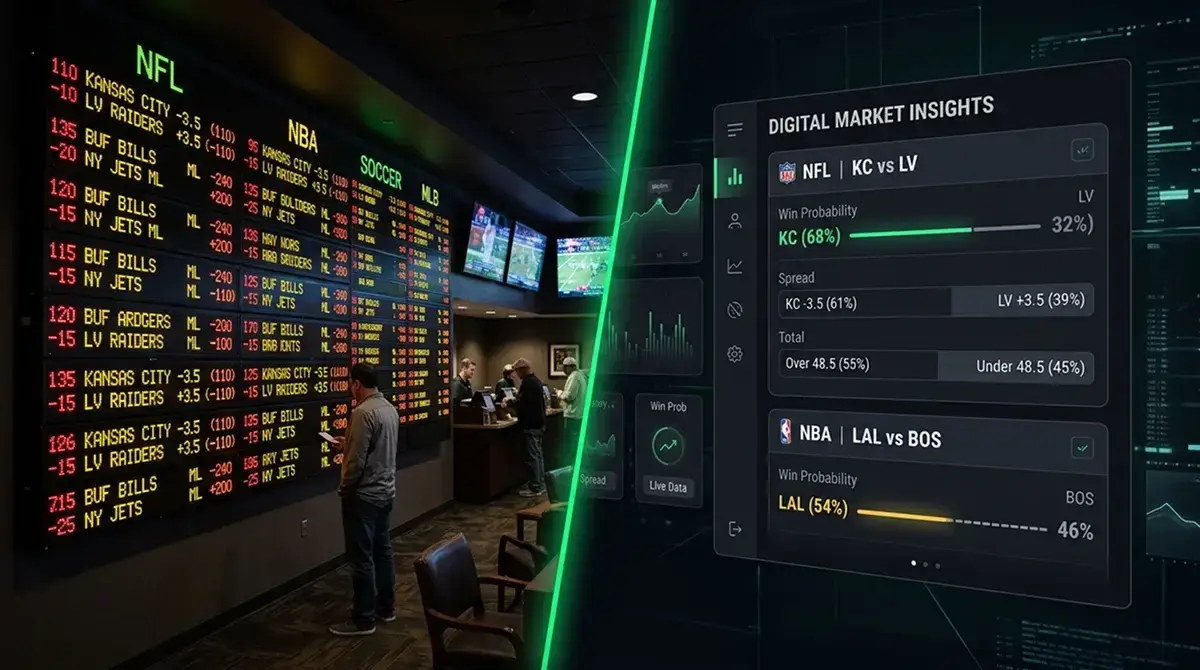

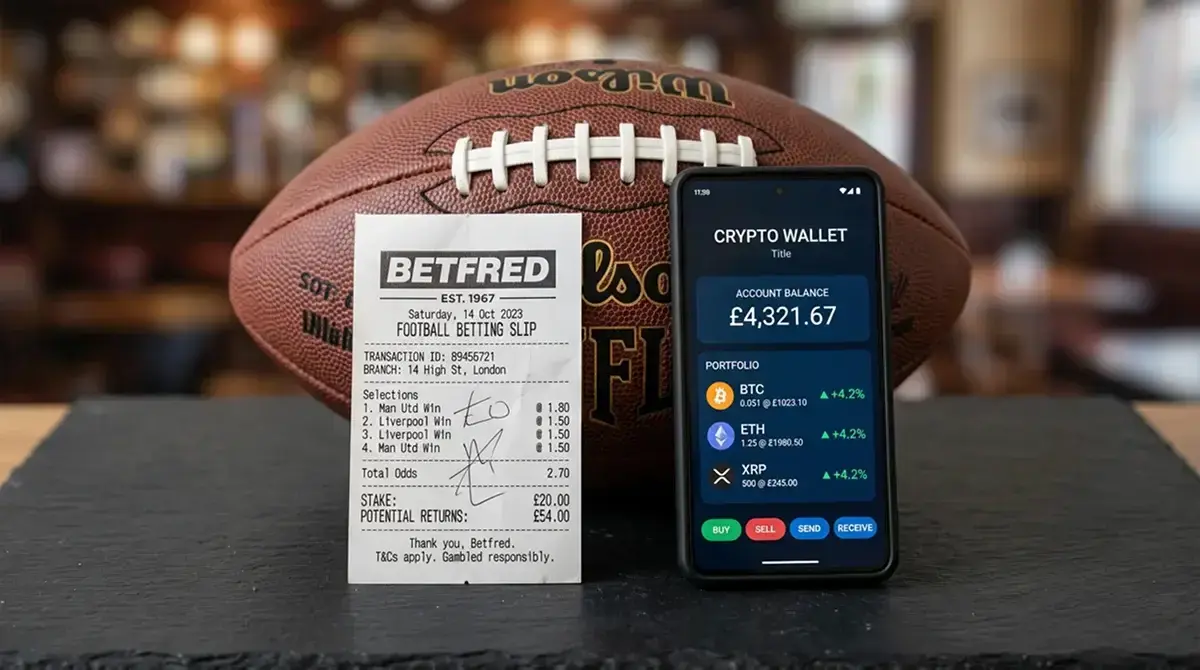
Andrew Rhodes, CEO of the UK Gambling Commission, framed the tension plainly: “What I thought was a five-year-away problem, perhaps a year or two ago, I think is now an 18-month to two-year challenge.” He was speaking about the integration of cryptocurrency into the regulated gambling market, and his timeline underscores just how urgently the two worlds, crypto sportsbooks and traditional UK bookmakers, are converging.
For UK bettors placing NFL wagers, the choice between these models is not theoretical. It is a decision you make every time you open your phone on a Sunday evening. Each model wins in specific areas and loses in others. The goal of this comparison is to lay out the trade-offs with enough precision that you can make the choice that fits your priorities.
Odds and Margins: Sportsbook Model Comparison and Payoffs
Odds are the bedrock of any sportsbook comparison, and the picture here is less one-sided than many crypto advocates claim.
UK-licensed bookmakers typically operate with NFL margins of 5-7% on standard markets: moneyline, spread, totals. The margin is the sportsbook’s built-in advantage, embedded in the odds. A spread bet priced at -110 on both sides represents a margin of approximately 4.5%. UK bookmakers often price slightly wider, particularly on less popular NFL games.
Crypto sportsbooks, especially the larger operators, frequently offer tighter margins. Reduced-juice lines at -105 or -103 are not uncommon, and some platforms advertise margins under 3% on select NFL markets. This is a genuine advantage. Over a full NFL season of 50-100 bets, the cumulative difference between 5% and 3% margin is significant. It can be the difference between a marginally profitable season and a marginally losing one.
Where UK bookmakers compete is on special markets and enhanced odds promotions. Price boosts on NFL same-game parlays, enhanced odds for new customers, and odds guarantees (best odds guaranteed on certain markets) have no real equivalent on most crypto platforms. These promotions are loss leaders. The bookmaker absorbs a cost to attract volume, and they can deliver genuine value for alert bettors.
The UK’s online gambling sector generated L7.8 billion in gross gambling yield (a 13.1% year-on-year increase) per Gambling Commission data. That revenue funds the promotional ecosystem. Crypto sportsbooks, by contrast, compete primarily on raw odds and market depth rather than promotional generosity. Which model delivers better value depends on your bet volume, bet types, and willingness to chase promotions.
Deposits, Withdrawals and Payment Friction
Payment speed is where crypto makes its clearest case. On a UK-licensed bookmaker, depositing via debit card is instant and withdrawing takes one to five business days. Apple Pay and bank transfer options have narrowed the gap, but same-day withdrawals of large amounts remain unusual.
On a crypto sportsbook, Bitcoin deposits confirm in 10-30 minutes and stablecoin deposits on Tron confirm in seconds. Withdrawals follow the same timeline, once approved, the blockchain processes them in minutes rather than days. For bettors who want to move funds between platforms during an NFL weekend – chasing better lines or rebalancing after a win – crypto’s speed is a material advantage.
The friction sits elsewhere. Buying crypto in the first place requires a UK exchange, identity verification, and a purchase that itself takes time. Converting winnings back to GBP adds another step. The total time from “pounds in your bank account” to “bet placed” and back to “pounds in your bank account” is often longer with crypto than with a debit card on a UK bookmaker – the middle is faster, but the ends are slower.
Credit cards add another wrinkle. The UK banned credit card gambling deposits in April 2020, a restriction that applies to all UKGC-licensed operators. Crypto sportsbooks, operating offshore, face no such restriction in practice, though most UK credit card providers now block transactions to crypto exchanges as a separate policy. The net effect is that both models funnel UK bettors toward debit cards or bank transfers for the initial purchase of betting funds, and crypto simply adds a conversion layer on top of that base step.
The UK gambling market supports approximately 22.5 million consumers, per Gambling Commission estimates, and the vast majority use traditional payment methods. For those consumers, the debit card path is simpler. For the subset already holding crypto, or willing to learn – the speed advantage during the betting window is real, even if the on- and off-ramps add complexity.
Consumer Protection: UKGC Licence vs Offshore Alternatives
This is the comparison where crypto sportsbooks lose, unambiguously.
A UKGC-licensed operator must segregate customer funds, submit to regular audits, participate in the GamStop self-exclusion scheme, implement affordability checks, offer complaint resolution through IBAS, and comply with advertising standards. The Commission has backed this framework with aggressive enforcement against unlicensed operators, per its CEO Briefing, issuing hundreds of takedown notices and securing the removal of thousands of URLs from search results.
Offshore crypto sportsbooks operate under lighter regulatory regimes. A Curaçao licence, the most common among crypto operators, imposes fewer requirements on fund segregation, responsible gambling tools, and complaints handling. Some crypto platforms hold no licence at all. If a dispute arises, your options range from limited (filing a complaint with a Curaçao regulator who may take months to respond) to nonexistent (no regulator, no recourse).
The practical impact for UK NFL bettors is straightforward. On a UKGC-licensed platform, if a sportsbook incorrectly settles your Super Bowl bet, you have a defined escalation path: internal complaint, then IBAS, and then ultimately the courts. On an offshore crypto sportsbook, you have a support ticket. The protection gap here is not at all abstract. It is the difference between having recourse and having hope.
The duopoly of FanDuel and DraftKings controls roughly 75% of the US regulated market (39.6% and 35.3% respectively) per CompaniesHistory data, and their presence in the UK-accessible market through odds comparison provides a benchmark for what regulated NFL betting looks like. Crypto sportsbooks offer advantages in odds and market depth, but they do so without the safety net that regulation provides. For bettors who prioritise value and accept the trade-off, crypto is a rational choice. For those who prioritise protection, the UKGC-licensed market, despite its narrower NFL offerings – is the safer path. The honest answer is that neither model is categorically better; they serve different priorities, and understanding which priorities are yours is the real decision.
There is also a practical middle path that some UK bettors adopt. They maintain accounts with both a UKGC-licensed bookmaker and an offshore crypto sportsbook, using each for what it does best. The licensed bookmaker handles the core of their NFL betting, providing robust regulatory protection, reliable and proven cash-out options, and bank-integrated deposits. The crypto sportsbook serves as a supplementary platform for prop markets, niche futures, and situations where the odds differential is large enough to justify the reduced consumer protection. This dual approach requires more administrative overhead and careful organisation, carefully managing two separate bankrolls, tracking results across platforms, and maintaining separate records for tax purposes, but it effectively captures the distinct strengths of each model while limiting exposure to the weaknesses of either.