

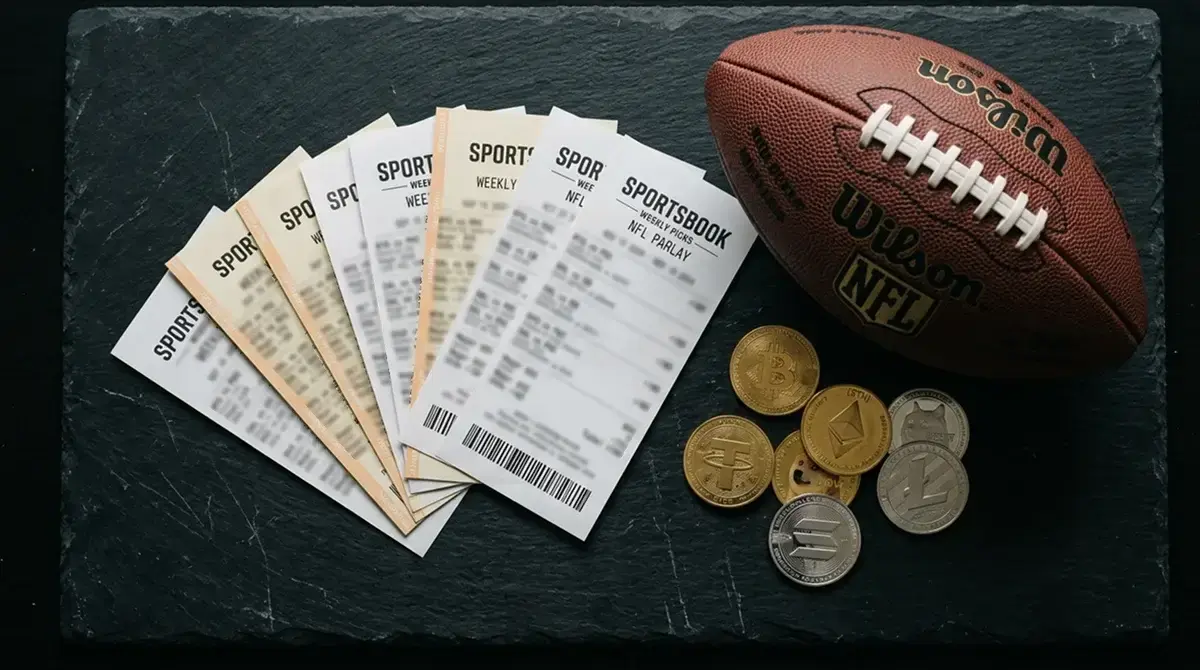
The total volume of legal sports wagers in the United States reached £132 billion in 2025, with operator revenues hitting £13.4 billion (22.8% year-on-year increase, per the American Gaming Association and SportsBettingDime. A disproportionate share of that revenue comes from one bet type: the parlay. Sportsbooks love parlays because the house edge compounds with every leg you add. Bettors love parlays because a L10 stake can return L500 if everything hits. That tension) enormous theoretical payouts against compounding mathematical disadvantage – defines parlay betting, and it does not change just because you are paying in Bitcoin.
What does change on crypto platforms is the execution environment. Different margin structures, different payout mechanics, and different bankroll dynamics all affect how parlays perform when your stake is denominated in cryptocurrency. As Bill Miller, president and CEO of the American Gaming Association, put it when discussing NFL betting: legal sports betting enhances the fun and friendly competition that make NFL games even more special. Parlays are the purest expression of that fun, and also the fastest way to empty a bankroll if you do not understand the maths behind them.
To increase your parlay payouts, consider adding highly correlated NFL player prop bets to your ticket.
NFL Crypto Parlay Mechanics and Sportsbook House Edge
A parlay is a single bet that combines two or more individual selections – called legs – into one wager. Every leg must win for the parlay to pay out. If any single leg loses, the entire bet loses. That is the core mechanic, and it works identically whether you are betting in pounds, dollars, or satoshis.
On a crypto sportsbook, you build a parlay the same way you would on any online platform. Select your first market – say, the Bills moneyline. Add a second (the Chiefs to cover -3.5. Add a third) the Bengals/Ravens game to go over 47.5 total points. The platform calculates the combined odds by multiplying the decimal equivalents of each leg, and displays the potential payout in your deposited cryptocurrency.
Where crypto platforms diverge from traditional UK bookmakers is in the odds offered on individual legs. Crypto sportsbooks frequently operate with lower margins on straight bets, which mathematically flows through to better parlay payouts. A three-leg parlay where each leg carries a 4% margin pays out differently from one where each leg carries a 6% margin, and over time, that difference matters. The compounding effect works in both directions: lower single-leg margins compound into meaningfully better parlay prices, just as higher margins compound into worse ones.
Most crypto sportsbooks settle parlays in the same currency you deposited. Win a 0.01 BTC parlay at combined odds of +2500, and you receive 0.25 BTC plus your original stake. The settlement happens after the final leg resolves, which for an NFL Sunday parlay might be after Sunday Night Football, roughly eight to ten hours after the early games kicked off. Your payout sits in your account balance, available for withdrawal or further wagering.
Parlay Bankroll Strategy When Betting with Crypto
The demographic data on crypto bettors tells a relevant story here. The primary audience for crypto gambling skews heavily toward the 25-34 age range, accounting for roughly 40% of all crypto bettors according to Bitmedia, with the 35-44 cohort following at around 35%. This is the same demographic most likely to be drawn to parlays and SGPs – younger, more risk-tolerant, and more attracted to high-payout structures.
The bankroll management principles that apply to fiat parlays apply equally to crypto parlays, but with an added consideration. Your bankroll is not just subject to gambling variance – it is subject to cryptocurrency price variance as well. A losing week on parlays during a BTC downturn hits twice: once from the bets themselves and once from the depreciation of your remaining balance.
The approach I recommend to anyone building parlays on crypto sportsbooks is a strict percentage-based system. Allocate no more than 1-2% of your total crypto betting bankroll to any single parlay. For a 0.5 BTC bankroll, that means individual parlay stakes of 0.005 to 0.01 BTC. This feels small, especially when you are looking at a four-leg parlay paying +1200 and imagining the return. But the hit rate on four-leg parlays is roughly 6-8% if you are a skilled handicapper, and lower if you are not. You need a bankroll that can absorb 15 or 20 consecutive losses without being materially depleted.
A second principle: separate your parlay bankroll from your straight-bet bankroll. Parlays are entertainment with a mathematical disadvantage. Straight bets are where consistent, long-term edge lives. If you mix the two, the parlay losses will erode the profits from your straight bets and make it impossible to evaluate whether your overall approach to NFL odds and value is actually working.
Finally, resist the temptation to build parlays as a way to recover from a bad day. The compounding house edge means that chasing losses with increasingly ambitious parlays is the fastest path to a zeroed-out balance. Place your parlays as planned bets, not as emotional responses. The dopamine hit of watching a four-leg parlay track through its final leg is real and addictive. Make sure it is funded by a budget you have already mentally written off, not by money you need to see again.