
Crypto casinos now account for roughly 17% of all global wagers in iGaming, according to the Surgence Labs Crypto Casino Industry Report. That is a remarkable share for a sector that barely existed a decade ago, and much of its growth has been built on a single promise: provably fair outcomes. The idea is seductive: a mathematical guarantee that the house cannot manipulate results, verified through cryptographic hashes that anyone can check. For slots and dice games, where the platform generates the outcome, this promise is technically deliverable. For NFL betting, where outcomes are determined by 22 athletes on a football field 5,000 miles from any blockchain, the picture is considerably more complicated.
I have spent years explaining to clients the gap between what “provably fair” means in theory and what it can actually verify in practice when applied to sports wagering. That gap is the subject of this article.
Cryptographic Hash Verification on NFL Crypto Platforms
Before I explain what provably fair can and cannot do for NFL bettors, it helps to understand the underlying mechanism. The technology is elegant, and in its native context (casino games) it genuinely works.
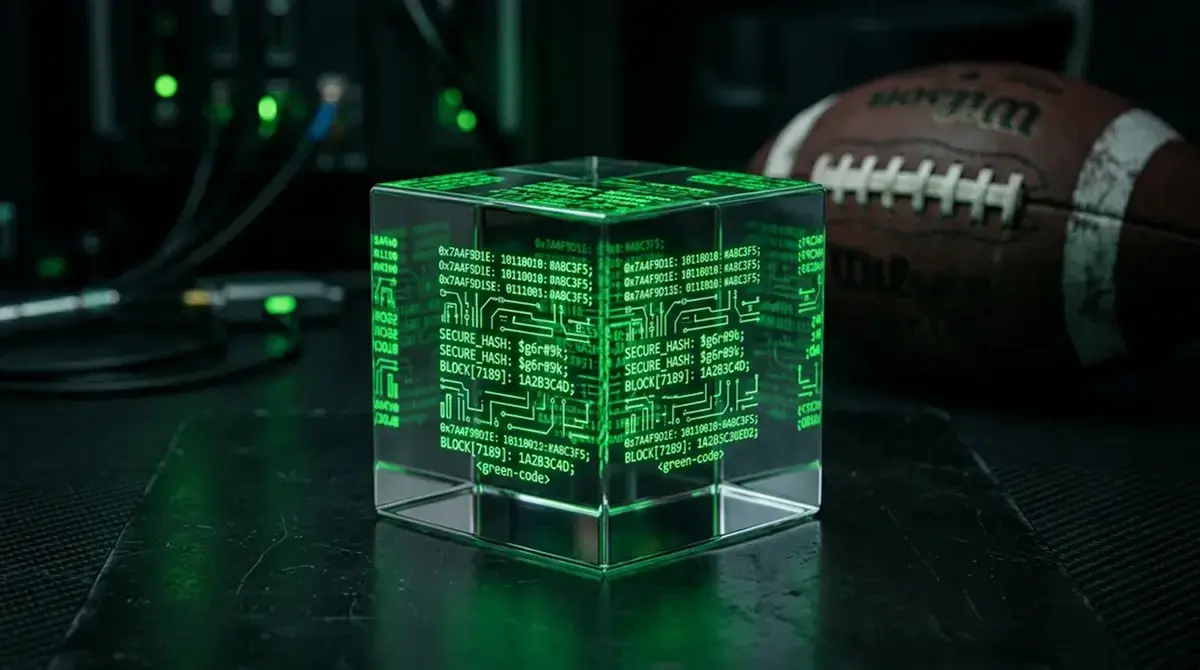
A provably fair system operates on a commit-reveal scheme using cryptographic hashes. Before a game round begins, the platform generates a random seed, a string of characters that will determine the outcome. This seed is run through a hash function (typically SHA-256), which produces a fixed-length output called a hash. The hash is shared with the player before they place their bet. After the round resolves, the platform reveals the original seed. The player can then run the seed through the same hash function to verify that the hash matches what they were given beforehand.
The critical property of a hash function is that it is a one-way operation. You can generate the hash from the seed, but you cannot reverse-engineer the seed from the hash. This means the platform cannot change the outcome after committing to it, because any change to the seed would produce a different hash that would not match the one shared with the player. The player does not need to trust the platform. They can mathematically verify that the outcome was determined before their bet was placed.
For a coin flip, a dice roll, or a slot spin (games where the platform itself generates the random outcome) this is a genuine and powerful guarantee. The player has cryptographic proof that the result was not rigged. It is one of the few areas where blockchain technology delivers a clear consumer benefit over traditional alternatives.
Can NFL Sportsbook Outcomes Be Provably Fair?
Here is where things get tricky, and where I see the most confusion among punters attracted to crypto sportsbooks by the “provably fair” label.
An NFL game outcome is not generated by the sportsbook. It is determined by events on a physical football field: touchdowns, field goals, penalties, turnovers, clock management. No cryptographic hash can commit to Patrick Mahomes throwing an interception in the third quarter. The outcome is external to the platform, which means the core provably fair mechanism (commit to a seed, reveal it later) simply does not apply to the result itself.
What a provably fair system can verify in the context of sports betting is more limited but still meaningful. It can prove that the odds you were offered at the time of bet placement were genuinely recorded and not altered after the fact. It can prove that your bet was accepted before the outcome was known. It can prove that the payout calculation was performed correctly based on the recorded odds and the verified result. These are important transparency guarantees, but they are qualitatively different from proving that the outcome itself was not manipulated.
Some crypto sportsbooks market themselves as “provably fair” without distinguishing between outcome verification (which they cannot provide for sports) and process verification (which they can). I have encountered platforms that display hashes prominently on their NFL betting pages as a trust signal, even though those hashes verify nothing about whether the odds were fair, whether the lines were competitive, or whether the platform would actually honour a large payout. The hash confirms that a number was committed before a bet was placed. It does not confirm that the number represents a fair price.
For NFL bettors evaluating crypto sportsbooks, the provably fair label should prompt specific questions rather than blanket reassurance. What exactly is being hashed? What does the verification prove? And what aspects of the betting process remain unverifiable?
Smart Contracts and Oracle Dependencies in NFL Betting
A more ambitious application of blockchain to NFL betting involves smart contracts – self-executing programs on a blockchain that automatically process bets based on external data feeds called oracles. Crypto gambling accounts for 30% of all online wagers globally in 2025, up from 20% in 2022 per Platinum Crypto Academy, and a growing share of that volume runs through smart-contract-based protocols rather than traditional centralised sportsbooks.
The architecture works like this. A smart contract on Ethereum or a similar blockchain holds the terms of a bet: the selection, the odds, the stake, and the conditions for settlement. When the NFL game concludes, an oracle (data feed that brings off-chain information onto the blockchain) reports the result to the smart contract. The contract then automatically distributes the payout to the winner and returns the house’s share, all without human intervention.
The appeal is obvious. No withdrawal delays, no manual approval process, no risk that the sportsbook decides not to pay. The contract executes as written, and the blockchain provides an immutable record of every transaction. For anyone who has ever waited three days for a withdrawal approval on a centralised crypto sportsbook, the appeal of automated settlement is tangible.
The vulnerability is in the oracle. The smart contract is only as trustworthy as the data feed that tells it who won the game. If the oracle reports an incorrect result, whether through error, manipulation, or downtime, the smart contract will faithfully execute an incorrect settlement. “Code is law” works beautifully when the code is processing accurate data. When it is not, there is no customer service department to call and no dispute resolution process to invoke.
Oracle manipulation is not a theoretical concern. DeFi protocols have suffered oracle attacks where manipulated price feeds triggered incorrect contract executions, resulting in millions of dollars in losses. Applying the same architecture to NFL betting introduces the same vulnerability. Who operates the oracle? What data sources does it use? What happens if the oracle goes offline during a game? These questions do not have standardised answers across the crypto sportsbook landscape, and the answers vary dramatically between protocols.
The technology is advancing rapidly – multi-oracle systems, reputation-staked data providers, and decentralised consensus mechanisms all aim to reduce single-point-of-failure risk. But as of today, no smart-contract-based NFL betting protocol has achieved the reliability and throughput needed to compete with centralised sportsbooks on the experience that matters most to bettors: fast bet placement, accurate odds, and guaranteed payouts. The provably fair promise of blockchain applied to NFL betting remains more aspiration than reality – valuable in principle, limited in practice, and worth understanding clearly before you trust your money to it.