
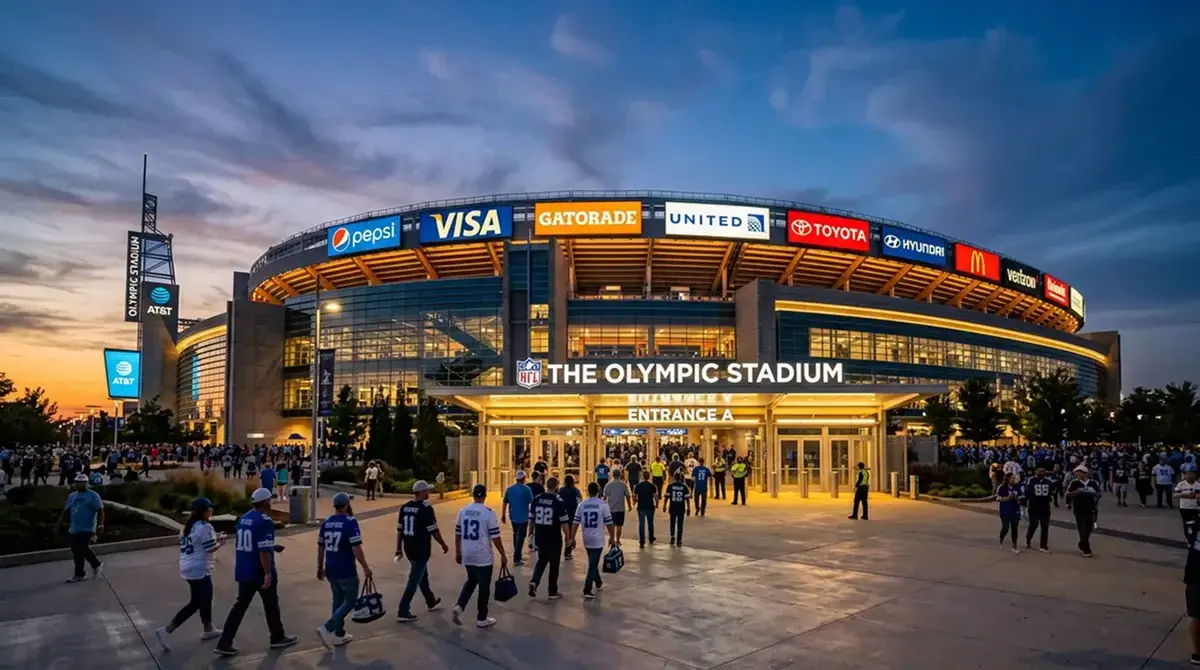
Walk into any NFL stadium and you will see it before you find your seat: gambling logos on the scoreboard, the concourse, the broadcast overlay. The league that once treated sports betting as an existential threat now counts it as a core revenue stream. NFL team sponsorship revenue reached £2.1 billion in 2025 – up 8% year-on-year, and gambling-related sponsorships alone contributed approximately £104 million, according to data from SponsorUnited, the Washington Post, and Yogonet.
That £104 million figure represents a dramatic transformation. A decade ago, no NFL team had a gambling sponsor. Now, the relationship between the league and the betting industry is structural – woven into broadcast deals, stadium naming rights, and official league partnerships. The question this article explores is where crypto fits into that picture, and what it means for UK bettors watching from across the Atlantic.
When Crypto Sportsbooks Sponsor Football Clubs
While crypto operators are largely excluded from NFL sponsorship, they have been active sponsors of football (soccer) clubs, particularly in the English Premier League. The results have been controversial, and Andrew Rhodes, CEO of the UK Gambling Commission, has been notably direct on the subject, stating that “the Commission thinks it is wrong that people are sponsoring football clubs who don’t have a licence in this country.”
Rhodes’s concern is specific: offshore crypto sportsbooks that sponsor Premier League clubs are gaining brand visibility among UK consumers without meeting the licensing standards that UK-based operators must satisfy. The sponsorship creates a commercial relationship that implies legitimacy without the regulatory substance behind it. For a UK bettor who sees a crypto sportsbook’s logo on a Premier League shirt, the association with a trusted club can create a false sense of security about the platform’s accountability and consumer protections.
This dynamic has direct relevance for the crypto gambling market’s legitimacy in the UK. If offshore operators can access UK audiences through club sponsorships without holding a UKGC licence, the regulatory framework has a visible gap. The Commission has pushed for changes, and Premier League clubs have faced growing scrutiny over these partnerships. Several prominent clubs have already moved away from gambling sponsorships entirely, though others continue to accept them.
The NFL’s approach differs markedly. Because the league controls its sponsorship programme centrally and restricts partners to licensed operators, the kind of unlicensed-sponsor controversy that plagues English football simply does not arise in American football. An NFL team cannot sign a sponsorship deal with a Curaçao-licensed crypto sportsbook, period. The centralised control eliminates the problem at the source.
UK Advertising Rules and the Crypto Gambling Gap
Advertising regulations in the UK have tightened significantly, and crypto gambling brands find themselves caught in multiple overlapping restrictions. Since 1 May 2025, operators have been required to obtain explicit, product-by-product and channel-by-channel consent before sending direct marketing to customers, per ICLG’s summary of UK gambling legislation. This consent rule applies to all operators targeting UK consumers, including offshore platforms, though enforcement against unlicensed operators is inherently more difficult.
The Advertising Standards Authority and the Gambling Commission jointly regulate gambling advertising content in the UK. Rules prohibit ads that target children, use misleading bonus claims, or imply that gambling is a reliable source of income. Crypto sportsbooks are technically subject to these rules when their advertising reaches UK audiences, but enforcement relies on the ASA identifying and acting against ads that may originate from offshore entities operating through social media channels and affiliate networks.
The gap is fundamentally structural. A UKGC-licensed operator that runs a non-compliant ad on UK television faces swift regulatory consequences. An offshore crypto sportsbook that runs a non-compliant ad via an Instagram influencer faces a much longer enforcement chain, if enforcement reaches them at all. The practical effect of this enforcement gap is that UK bettors encounter crypto gambling marketing that would not pass UKGC scrutiny if it came from a licensed operator.
Affiliate marketing deserves particular scrutiny in this context. Many crypto sportsbooks rely heavily and increasingly on extensive affiliate networks: websites, social media accounts, and content creators who earn commissions for every new depositing customer they refer. These affiliates are incentivised to promote aggressively and may exaggerate the safety or profitability of a platform. In the UK, the ASA holds affiliates to the same advertising standards as operators, but identifying and enforcing against thousands of individual affiliates, many based overseas, is a practical impossibility. When evaluating a crypto NFL sportsbook, look well past the affiliate recommendation and independently examine the platform’s credentials directly.
For bettors, this creates an information-quality problem. The ads and promotions you see for crypto NFL sportsbooks may not have passed through any regulatory filter. Bonus claims, odds guarantees, and safety assurances should be evaluated with that context in mind. The absence of NFL-level sponsorship branding is actually a useful signal – it tells you the platform has not met the standards required for that tier of commercial partnership, which in turn tells you something about its regulatory standing.
The sponsorship landscape is also a window into where the industry is heading. If major crypto sportsbooks begin obtaining UKGC licences or equivalent regulated status, they would gain access to legitimate sponsorship opportunities, including partnerships with NFL properties for UK-hosted events. That prospect remains speculative, but the commercial incentive is enormous. A crypto sportsbook with legitimate NFL branding and UKGC licensing would have a competitive advantage that no amount of affiliate marketing could replicate. Until that day arrives, the sponsorship channel remains closed to crypto operators, and their marketing relies on less regulated and less trustworthy channels that UK bettors should approach with appropriate scepticism.